
Strengthening ESG Impact: TUHF’s Strategy for Sustainable Affordable Housing
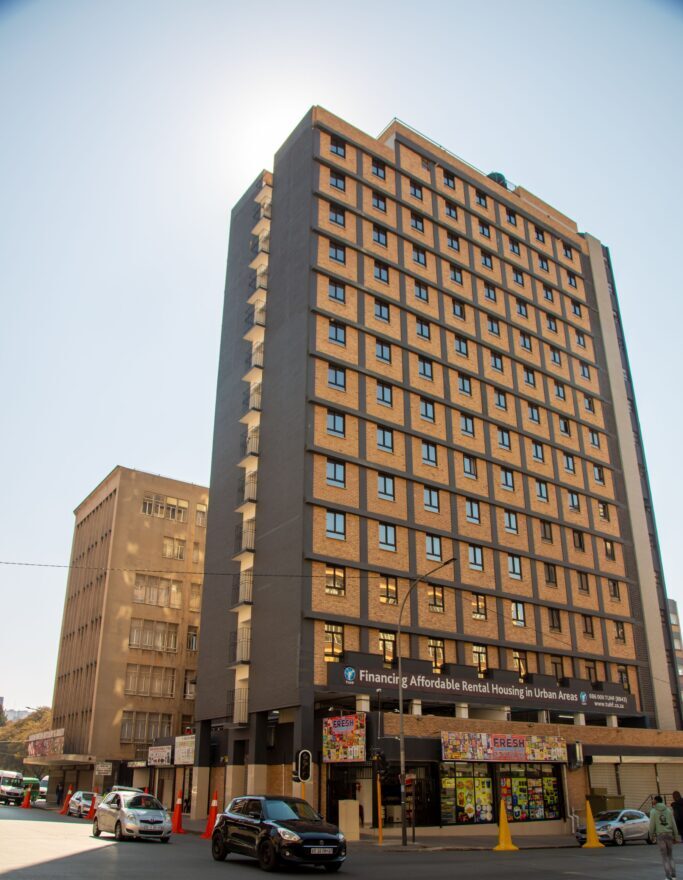
TUHF has reached an important milestone in its journey towards deeper environmental, social and governance (ESG) tracking and reporting, using a new Environmental and Social Management tool developed with support from the Proparco-implemented and European Union-funded “Crisis Emergency Response Technical Assistance Facility” (CERTAF), a technical assistance facility available to financial institutions in Sub-Saharan Africa and EU neighbourhood countries.
Following the implementation of a CERTAF-supported Environmental and Social Management System (ESMS), TUHF is now better equipped to manage its ESG strategy, with a heightened focus on environmental and social impact.
TUHF’s ESG strategy is supported by its drive to develop Excellence in Design for Greater Efficiencies (EDGE) certified projects, such as Remington House – the first flagship inner-city redevelopment project in Johannesburg’s CBD. EDGE is a World Bank Group-developed green building standard that verifies at least 20% reduction in energy, water, and embodied carbon in materials for new or existing buildings. With increasing numbers of EDGE certified projects, TUHF has demonstrated that environmental efficiencies are an important consideration for all new financed projects.
The ability to EDGE-certify projects and the strengthened measurement and reporting capability of the ESMS amplifies TUHF’s role as an impact investor of choice in South Africa.
Accurate measurement key to sustainable development
TUHF’s ESMS tool is now used to assess environmental and social risk across TUHF-funded projects, with ESG integrated into TUHF’s systems so that every project undergoes ESG screening prior to credit approval. The technical assistance provided by Proparco was instrumental in strengthening TUHF’s ESG integration and reporting capabilities.
Commenting on the ESMS tool, Katherine Cox, Research & Development Impact Manager at TUHF21, says, “By strengthening TUHF’s ability to assess and manage environmental and social risk, this work enables us to demonstrate our impact to investors and funders. In turn, we are better enabled to offer finance to entrepreneurs to develop sustainable, affordable housing properties like Remington House, which contribute directly to inclusive urban development.”
A project that reflects commitment to impact
Remington House reflects TUHF’s long-standing commitment to impact-driven investment. The former office building on Nugget Street in Johannesburg’s Inner City had been abandoned and hijacked, with no functioning services and significant health and safety risks. Its central location near places of work and economic opportunity, transport hubs, public amenities, the CBD’s fashion district, and major universities presented an opportunity to deliver social, economic, and environmental impact with the added benefit of inner-city regeneration.
“When the developer approached us, the building had been vacated, and they were seeking funding for redevelopment,” says Khumbulani Chikomo, Portfolio Manager at TUHF. “We had worked with this developer on a similar project before, so we knew they had the entrepreneurial capability. They had also invested their own money in the building’s clean-up efforts, demonstrating real commitment to the refurbishment. No banks would fund the project, but it’s right up TUHF’s alley.”
Environmental and social outcomes
TUHF’s intimate knowledge of the Johannesburg inner city, together with the developer’s proven track record in rental housing, supported the decision to fund the project. The refurbishment transformed a 1 000 m² hijacked building into a safe and compliant mixed-use development comprising six ground-floor retail units, over 120 residential units, and 40 secure parking bays, demonstrating the power of urban densification and efficient land use in well-located urban areas.
The ground floor accommodates retail space for six shops, while the first floor provides 40 secure parking bays and houses centralised heat pumps that replace traditional high-energy- consuming geyser systems. Residential accommodation is distributed across a four-floor extension and a 16-floor tower, with single occupant units designed to maximise usable space, natural light and ventilation, as well as a penthouse on the top floor. Each unit includes a self-contained kitchenette and ablution facilities.
Originally intended for family rentals, the building was later adapted to meet the demand for student accommodation, incorporating a study centre and gym after interest from nearby tertiary education institutions. The project forms part of a growing student precinct in the area, alongside other TUHF-funded developments, accommodating close to 1 000 students living and studying in and around the block.
The Lasting Impact of Proparco’s TA Support
The implementation of the ESMS, supported through Proparco’s CERTAF facility, not only strengthens TUHF’s internal environmental and social risk management—it also builds the organisation’s capacity to guide its clients through more advanced sustainability pathways, such as green building certification. Before the ESMS was introduced, TUHF had limited structured processes for assessing and tracking environmental performance across its portfolio. The new system created clear procedures, screening tools, and reporting requirements that enabled TUHF staff to identify opportunities for improved resource efficiency early in the project cycle. It also familiarised the team with IFC performance standards and green-building principles, which later proved essential in supporting clients through the IFC EDGE certification process.
With the ESMS in place, Remington House served as TUHF’s first pilot project for EDGE certification under its partnership with the International Finance Corporation (IFC). Although the building works had commenced before the ESMS was formally implemented, the new system equipped TUHF with the internal tools and expertise needed to support the developer through the EDGE process—particularly in collecting technical data, identifying resource-efficiency measures, and coordinating IFC’s verification requirements. Through this collaboration, TUHF clients who achieve EDGE certification receive a rebate of USD 1,000 per residential unit, paid directly toward the loan settlement, helping offset certification costs, accelerate loan repayment and improve project efficiency.
“It indicates that we are able to see a certification through,” says Khumbulani. “We’re proud of that. The greening also delivers tangible benefits for the entrepreneur, tenants, and the surrounding community.”
The EDGE certification reflects significant efficiency gains, including energy savings of 28%, water savings of 22%, and a 51% reduction in embodied carbon through materials, achieved largely by reusing the building’s existing structural frame, concrete, and steel elements. Additional sustainability interventions include low-flow water fittings, dual-flush toilets, LED lighting throughout the building, energy-efficient heat pumps, solar backup power, and improved facade glazing to reduce heat gain and loss.
Empowering SMEs with improved measurability
“Proparco’s commitment to strengthening the capacity of financial institutions like TUHF to invest in sustainable development activities, particularly those led by SMEs, is strongly aligned with TUHF’s goals,” says Lusanda Netshitenzhe, CEO, TUHF21. “Both organisations share a focus on sustainable urban development and the socio-economic multipliers thereof.” Remington House stands as a new benchmark for sustainable inner-city redevelopment and affordable housing, demonstrating that environmentally responsible building practices are both achievable and commercially viable in the affordable housing market.